



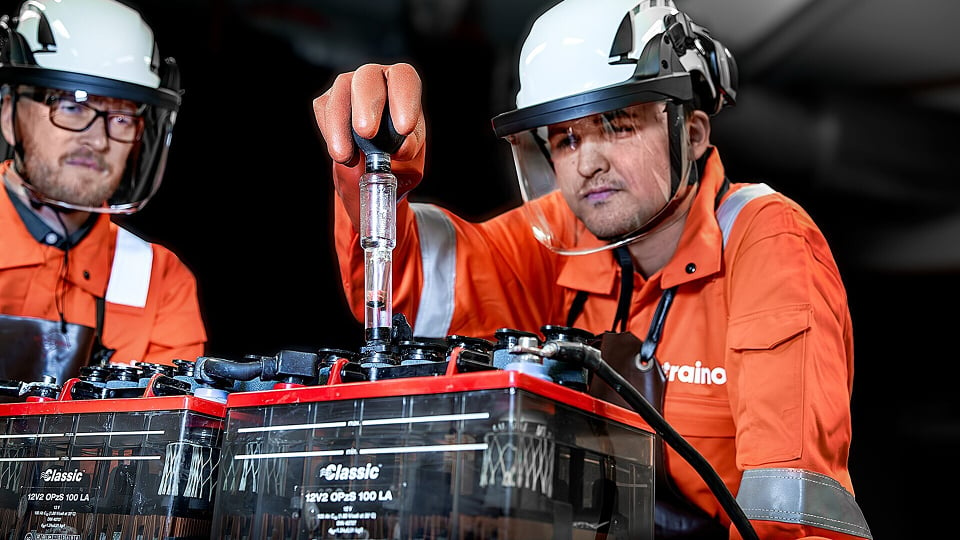
Battery systems are becoming increasingly common in both residential and commercial buildings. Work on batteries is classified as live-line work (AUS) due to the high risk of large short-circuit currents. For electricians and HSE managers, it is therefore very important to understand the requirements set by the authorities for the installation, operation, and maintenance of battery systems.
Live-line work (AUS)
When working with battery systems, one is exposed to high short-circuit currents that can trigger serious incidents such as arcing and fire. Therefore, work on batteries is classified as live-line work (AUS), which entails strict requirements for training and procedures.
- Training requirements: In accordance with the Regulations on Safety in Work on and Operation of Electrical Installations (FSE) and NEK EN 50110-1, everyone performing work under voltage, including work on battery systems, must have the necessary training. This includes both theoretical and practical training in safe work methods
- Safety procedures: Live-line work must always be performed in accordance with recognized methods and procedures that minimize the risk of accidents. This involves the use of specialized tools and protective equipment designed for work on high-voltage electrical installations.
Regulations and standards
Norwegian regulations for electrical installations are comprehensive, with several regulations and standards that specifically address battery installations.
- Regulations on Low-Voltage Electrical Installations (FEL): These regulations govern the design, installation, and maintenance of low-voltage electrical installations. Battery installations in residential buildings fall under these regulations, which require that the installation be carried out in accordance with the standards in NEK 400:2022.
- NEK 400:2022 Part 806: NEK 400 is a key standard for low-voltage electrical installations in Norway. Part 806 specifies requirements for battery installations, including measures to protect against electric shock, short-circuit currents, and fire risk. These requirements are based on international standards, including EN 62485-5.
- Risk Assessment Requirements: FEL requires that all work on electrical installations, including battery systems, be based on a thorough risk assessment. This involves assessing potential hazards and the necessary measures to ensure the safe execution of the work.
Practical considerations
When installing battery systems, several practical considerations must be taken into account to ensure compliance with regulatory requirements.
- Location of battery systems: Authorities recommend that batteries be placed in separate fire compartments, and preferably in external structures such as sheds or garages to reduce the risk in the event of a fire.
- Disconnection and protection: There is a requirement that battery systems must be capable of being disconnected from all live conductors, and that surge protectors and ground fault circuit interrupters suitable for direct current must be installed. This is particularly important in installations with high short-circuit currents that can occur in high-capacity batteries.
Conclusion
For electricians and HSE managers, it is crucial to have a full understanding of current regulations and requirements for training and safety when working with battery systems. Properly performed work can reduce the risk of hazardous incidents and ensure that installations operate safely and efficiently. Are you up to date on the latest requirements and safety standards for working with batteries? Now may be the time to review your procedures and training measures to ensure they meet regulatory requirements.
Related posts

How to ensure the safe use of NiCd batteries in emergency lighting systems
In this article, we take a closer look at how NiCd batteries are used in emergency lighting systems, what advantages and disadvantages they have, and how you can ensure safe and efficient use.
Safe use of battery types in electrical installations
This article gives you an overview of the three most common battery types, their areas of application, and the most important safety precautions.

Regulatory requirements for training on maritime battery systems
This article provides a detailed overview of the Norwegian Maritime authority's requirements for training and competence for those who operate, inspect, or maintain battery systems on board.